
Long before TikTok dances and viral hashtags filled our screens, a man named Richard Dawkins introduced a curious idea. In his 1976 book The Selfish Gene, he suggested that ideas move through culture much like genes move through biology. Just as DNA carries the blueprint of physical life, he believed that memes have the blueprint of thought—capable of replicating, mutating, and spreading from one mind to another.
At the time, his concept was mainly philosophical—an interesting theory for sociologists and scientists. Yet nearly fifty years later, we can see how prophetic it was. In the digital age, memes have become one of the most powerful forces shaping human life. What began as a clever metaphor has become a mechanism that molds the minds and hearts of an entire generation. Dawkins noted something subtle yet profound: memes don’t spread because they’re true—they spread because they’re catchy. That is their danger. A lie, if wrapped in humor or emotion, often travels farther than truth wrapped in reason. We see it every day. In fifteen seconds, a TikTok clip can circle the globe. A joke, slogan, or image can ignite emotions and gather millions of views. A teenager in Pennsylvania may repeat the same gesture or phrase as someone in Shanghai, unaware of its origin but connected by its rhythm.
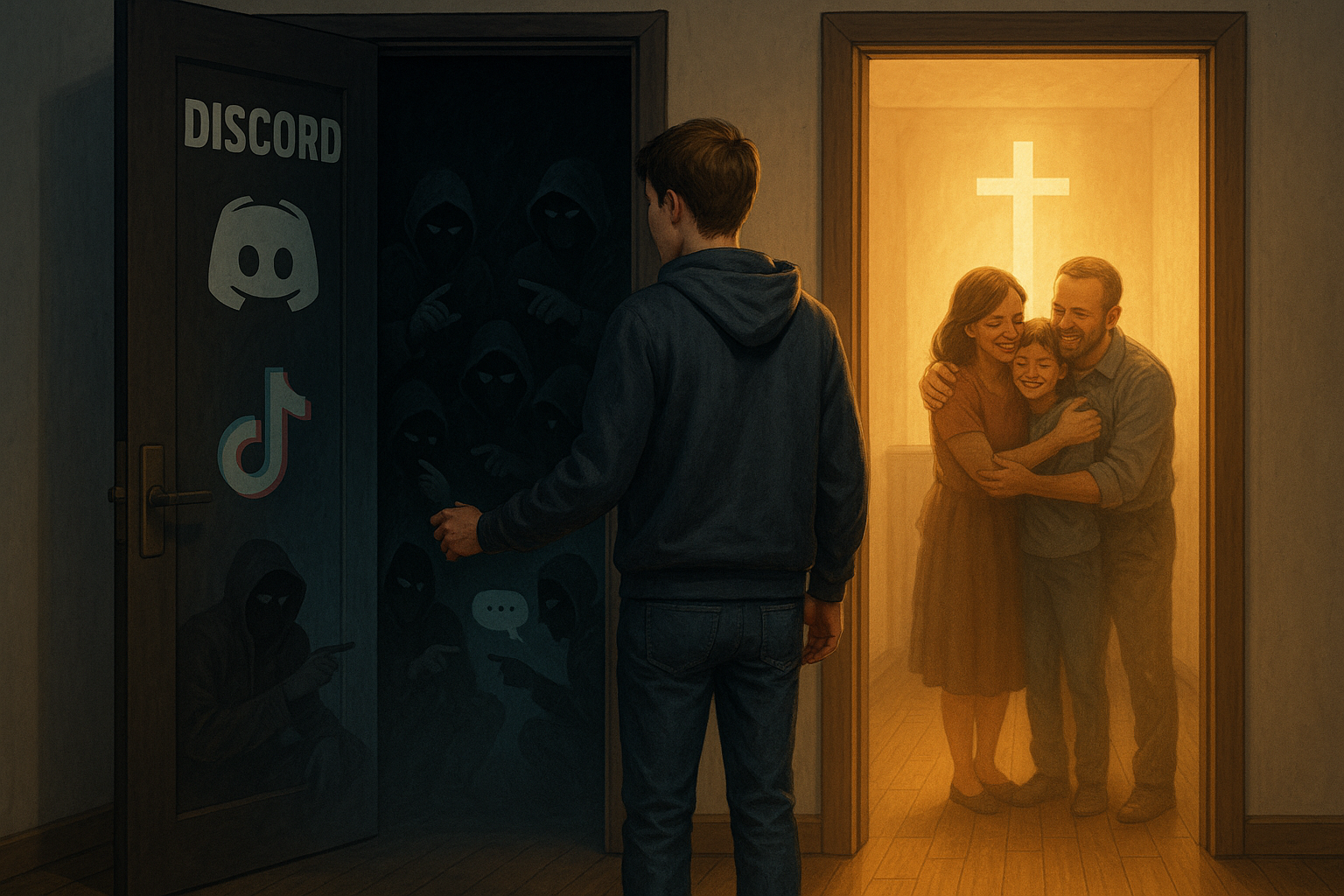
A platform called ‘Discord’, which wasinitially created for gamers, was officially launched in 2015 and quickly became one of the largest online platforms in the world. Today over 200 million use it daily for chatting, learning, and sharing interests. For many, it provides friendship and belonging. But for others, it can magnify loneliness, reinforce toxic patterns, and even become a breeding ground for radicalization.
Like TikTok, Instagram, or YouTube, Discord uses algorithms and private communities (servers) to connect people with similar interests. The results can be beautiful — or devastating. Prayer groups and Bible studies gather there, but so do communities that glorify hatred or violence. Some recent mass shootings have even been linked to planning and encouragement that happened in these hidden Discord groups. Technology doesn’t create evil, but it magnifies what is already there. And when discord (the platform) meets discord (the human condition), the results can spiral out of control.
Five Steps That Spirals Our Youth Towards Darkness:
1. Isolation: It begins with loneliness. A teenager, feeling misunderstood or unseen, retreats into a screen. At first, it feels like an escape. But gradually, the more time spent online, the less connected they feel in real life.
2. Echo Chambers: Soon, algorithms and online communities start feeding them more of what they already believe or fear. If they’re angry, they’ll find angry voices. If they’re wounded, they’ll find others who nurse similar wounds. Instead of broadening horizons, the digital world often narrows them.
3. Normalization of the Extreme: Content that once shocked begins to feel normal. Violent jokes, hateful memes, or harsh words no longer sting. A young man who once laughed at silly TikTok dances now scrolls past videos celebrating aggression or conspiracy theories.
4. Radicalization: The spiral accelerates. The isolated soul now has a tribe. But it is a tribe that fuels anger and glorifies rebellion. Conversations can foster hostility, portraying others as enemies. Ideas that once seemed unthinkable begin to feel like logical next steps. “For where you have envy and selfish ambition, there you find disorder and every evil practice” (James 3:16).
5. Tragic Action: Unchecked, the spiral ends in destruction. Sometimes it is self-destruction through addiction, depression, or despair. Other times, tragically, it erupts outward — in the form of mass shootings or violence that scars entire communities. The news headlines we see again and again are not random outbursts; they are the fruit of this downward spiral. “The thief comes only to steal and kill and destroy; I have come that they may have life, and have it to the full” (John 10:10).
Algorithms—The Invisible Tutor
Discord isolates, it strips people of trust, replacing belonging with suspicion. Left unchecked, it spirals downward into shame, rejection, and sorrow. But there is another way. When the Father’s love enters the picture, the atmosphere changes. The same hearts once burdened by heaviness begin to find release. Tears of despair give way to laughter. What once felt like chains suddenly loosens into freedom. This is connection not forged by anger or manipulated by algorithms, but one born of the Spirit—a bond that lifts us upward into hope and belonging.
The danger is subtle. You don’t realize you’re being discipled until you act out of the information you’ve received. Algorithms: The Invisible Tutor. If memes are the cultural DNA, then algorithms are the scientists in the lab, deciding which genes survive. TikTok, Discord, You Tube, Meta, and Instagram do not simply show us content; they mold us into what we observe. Their criteria is not truth but engagement. Does this video keep you watching? Does this meme make you react—laugh, cry, argue, or rage? Then it gets promoted. The machine doesn’t care about good or evil; it only cares about clicks. And so, like an invisible tutor, the algorithm disciplines us. It feeds us not what we need, but what keeps us hooked. A young man spends 10,000 hours online, and without a single political lecture, his worldview is formed—step by step, meme by meme, scroll by scroll.
Recently, headlines told of a 29-year old who opened fire at an ICE detention center. He wasn’t part of any extremist group. He had no manifesto, no political rant, no allegiance to a movement. But investigators found that he had spent more than ten thousand hours in online gaming communities. He wasn’t radicalized by ideology—he was shaped by culture. Slowly, through memes, messages and interactions, his imagination and sense of belonging were molded into something he himself never saw coming. That’s the sobering reality of our time, we are being shaped, slowly and steadily, by the unseen forces of what we watch , read, and repeat.
“The age of Charlie Kirk’s alleged assassin was 22. The young man who tried to assassinate Donald Trump was 20. Starting with Columbine in 1999, the age of mass shooters have been from 17 to 21 killing a total of 144, injuring 585. Many of the victims were children, slaughtered in their own schools. How can this be? Something is terribly broken here in our land, and it transcends questions of mental health or gun control or school security. May we pray for our young people like never before, may we get involved in their lives, may we strengthen our marriages and families, and may we bring this young generation a message of hope and redemption. Only the Lord can heal their wounds!”
Above Italics—Quoted from an article written by Dr. Michael Brown.
The battlefield for the minds of all those alive in this time appear to be escalating to create ungodly strongholds in a subtle and addictive technological era. The Gospel is relevant for every time, season, and culture. May we be used as His vessels of love to a broken world as long as we ever can!
Blessings and In His Love Always,
Leave a Reply