
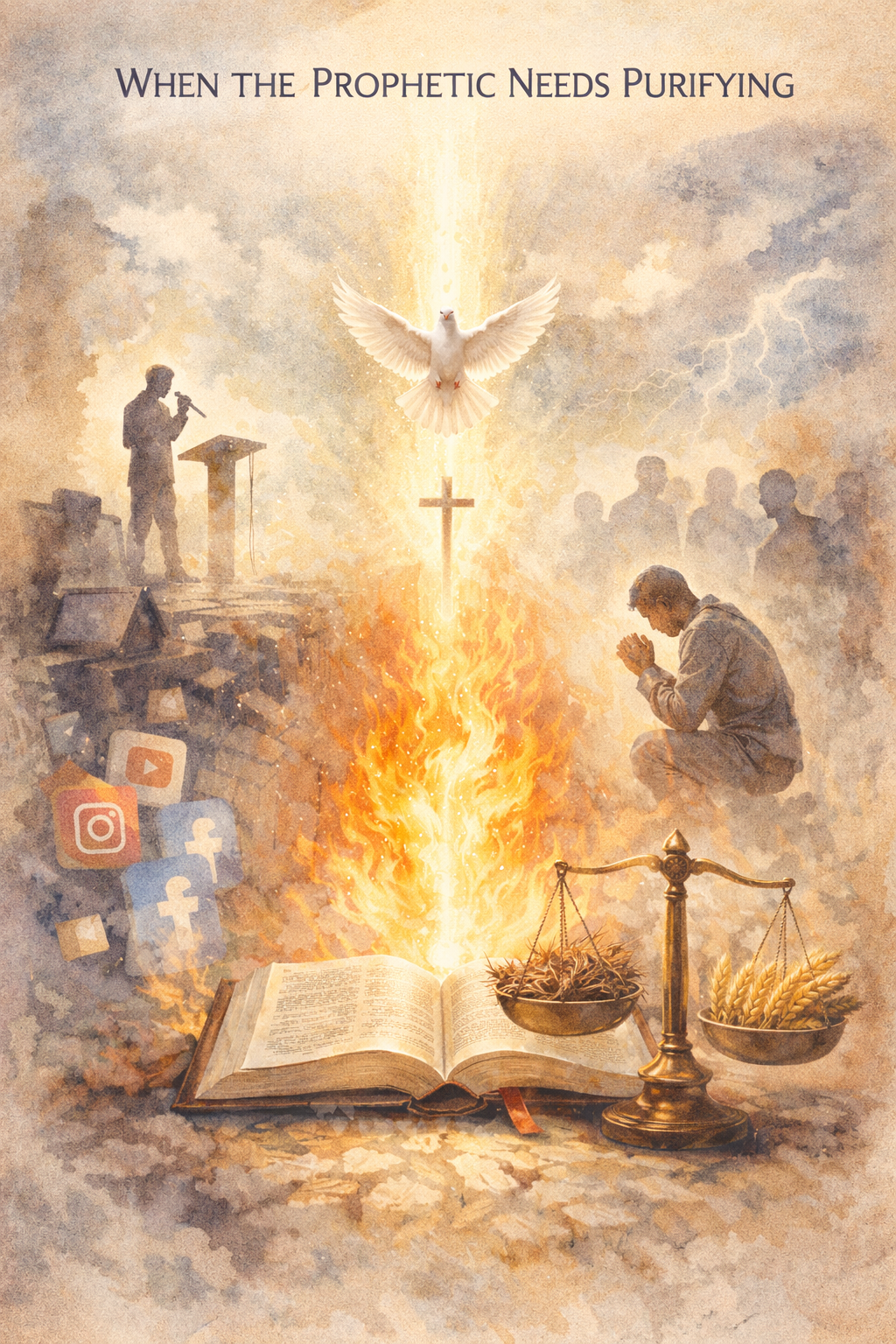
There are moments in the life of the Church when we are forced to pause, take a breath, and look honestly at what is happening among us. Not to accuse, Not to tear down. But to discern. Scripture calls us to test all things and hold fast to what is good (1 Thessalonians 5:21). That is not the language of suspicion—it is the language of a love that refuses to settle for imitation when the real is available. We are living in such a moment now, especially when it comes to the prophetic.
For decades, many of us have prayed for God to restore the prophetic voice to His Church—not as spectacle, nor performance, but as a genuine expression of His heart. The prophetic, at its core, is meant to reveal Jesus, strengthen His people, and call us back to alignment with His purposes. As Paul reminds us, “But the one who prophesies speaks to people for their strengthening, encouraging and comfort.” (1 Corinthians 14:3).
For many believers, recent discussions surrounding well-known prophetic figures, have been deeply troubling. Various reports and allegations have circulated suggesting the use of social media platforms—such as Instagram, YouTube, and Facebook—Data Mining to gather information that could appear as supernatural insights. There have also been serious claims concerning the misuse of spiritual authority and inappropriate conduct involving young men under Shawn’s influence. These claims have left many confused, grieved, and wrestling with questions about integrity and accountability in spiritual leadership.
It is important to say plainly; the pain the people feel is real. When trust is broken especially in spiritual leadership, it does not simply disappear with time. It leaves questions. And it leaves the Church wrestling with how to move forward without losing heart. But at this moment, and as painful as it is, it doesn’t have to lead us into cynicism. If anything, it calls us back to the purity of what the prophetic was always meant to be.
The Difference Between the Gift and the Vessel
One of the most important truths we must remember is that the failure of a vessel does not invalidate the gift. Scripture is filled with examples of flawed individuals whom God still used. Yet it is also filled with warnings about the danger of mixing God’s voice with human manipulation. Jeremiah spoke to this tension when he said, “Let the prophet who has a dream recount the dream, but let the one who has my word speak it faithfully. For what has straw to do with grain?” declares the Lord. ( Jeremiah 23:28) The question has never been whether the prophetic is real. The question has always been whether what is being spoken is truly from the heart of God. “We must diligently resist the temptation to think that spiritual power is always a mark of spiritual maturity. “When the fruit of the Spirit are made subordinate to the gifts of the Spirit, danger is ahead.” (Brian Blount)
Moments like what currently has taken place reminds us why discernment is not optional in the Christian life. Hebrews tells us that maturity comes to those “who by constant use have trained themselves to distinguish good from evil.” (Hebrews 5:14). Discernment is not suspicion; it is spiritual sensitivity. It is learning to recognize the difference between the voice of the Shepherd and the noise of human effort.
For too long, parts of the Church have equated supernatural language with spiritual authenticity. But the presence of spiritual language does not guarantee the presence of the Holy Spirit. Jesus Himself warned, “Many will say to me on that day, “Lord, Lord, did we not prophesy in your name, and in your name drive out demons and perform many miracles?’ Then I will tell them plainly, ‘I never knew you. Away from me you evildoers!’ (Matthew 7:22-23). These are sobering words, not meant to frighten us, but to ground us. God is not impressed by performance. He is moved by truth. These are sobering words, not meant to frighten us, but to ground us. God is not impressed by performance. He is moved by truth.
If there is one word that should mark the prophetic, it is humility. . True prophetic ministry does not elevate the messenger; it points to Jesus. It does not create dependency; it encourages intimacy with God. It does not manipulate emotions; it invites transformation. Micah captures this beautifully: “He has shown you, O mortal, what is good. And what does the Lord require of you? To act justly and to love mercy and to walk humbly with your God.” (Micah 6:8). Humility creates space for accountability. It welcomes correction. It recognizes that no one hears perfectly and that every word must be weighed within the community of faith. When humility is absent, even genuine gifts can become distorted.
Some may feel tempted to step away from anything prophetic altogether, reasoning that it is safer to avoid the possibility of deception. That response is understandable, but it would be a loss for the Church. Paul’s instruction remains clear: “Do not put out the Spirit’s fire; do not treat prophecies with contempt. Test everything. Hold on to the good. Avoid every kind of evil.”( 1 Thessalonians 5: 19-21) Notice the balance. We are told not to despise prophecy, but we are also told to test it. The answer is not rejection—it is refinement. God is not withdrawing His voice. He is purifying how we hear it.
So where do we go from here?
First we must return to the foundation of Scripture. Any prophetic word that contradicts the character of God revealed in His Word must be set aside.
Second, we need to embrace the community of discernment. No one should carry prophetic authority in isolation. Healthy prophetic culture is always accountable.
Third, we need to examine our hearts. The hunger for spiritual experiences must never replace the hunger for God Himself.
And finally, we extend grace without abandoning truth. Restoration is always possible where there is genuine repentance. Healing for the Church also requires honesty about what has happened, repentance for corporate failures, and seeking God first for His wisdom in going forward.
The prophetic was never meant to be a stage — it was meant to be a window through which we glimpse the heart of God. Even in moments of disappointment, the Holy Spirit continues to speak. He still comforts, still guides, still reveals Jesus. The failures of individuals cannot silence the voice of God. Jesus promised, “My sheep hear my voice; and I know them, and they follow me” (John 10:27). That promise remains steady, even when human leadership falters. Perhaps this season is an invitation — not to retreat, but to grow deeper roots. To become a people who value authenticity over spectacle, character over charisma, and truth over impression.
The prophetic is not dying. It is being refined. And refinement, though often uncomfortable, is always a sign that God is not finished with us yet.
Leave a Reply