
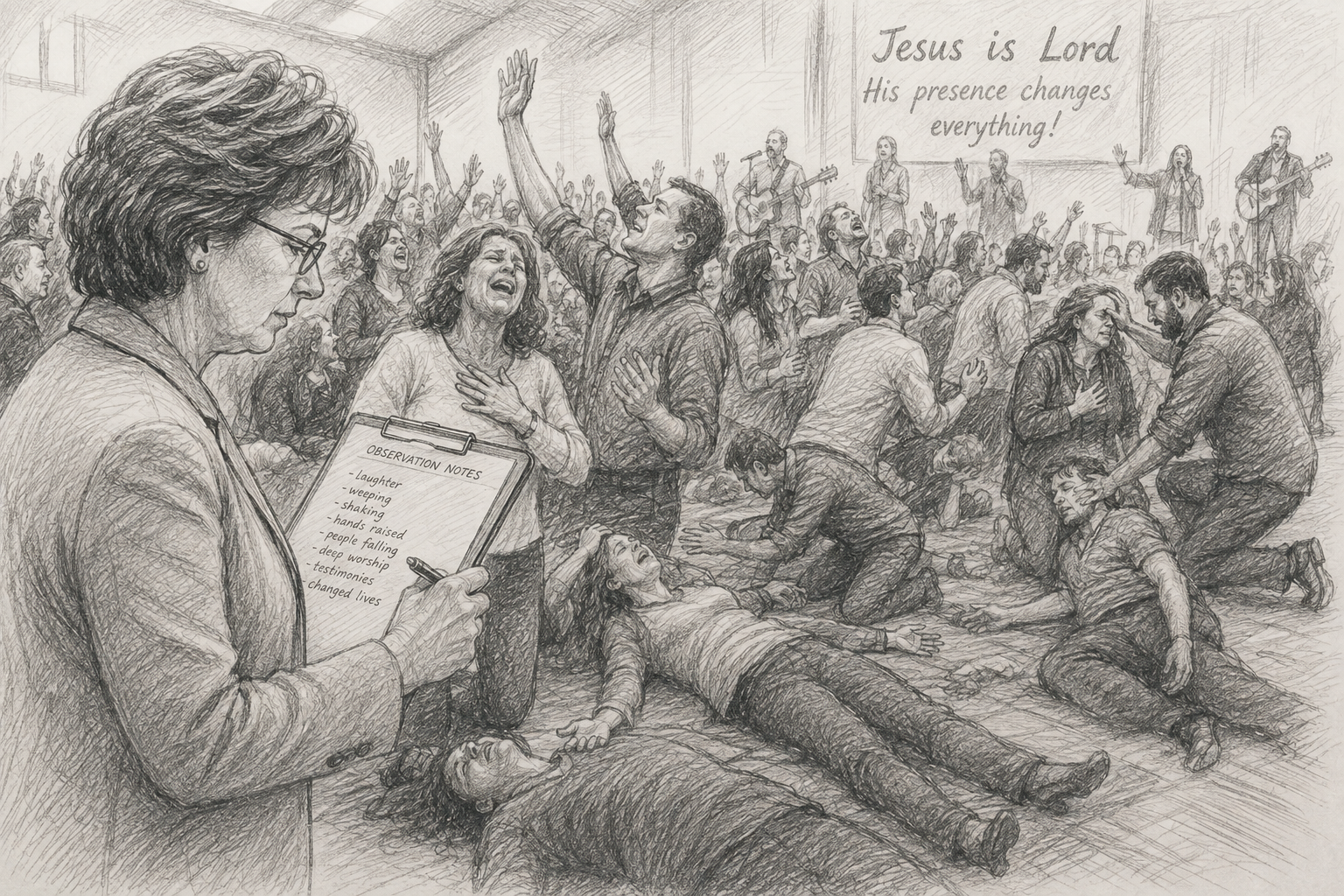
From everything I have discovered about past and present moves of God one thing is certain—It never comes without its misunderstandings. Some Christians are convinced that what is happening is most certainly God while others are not so sure of its validity. It all centered around the manifestations of the Holy Spirit which at times are questionable at best. Even if you have been around past moves of God some if not most of what happens can be hard to understand. When it happened at our Church in 1995 we spent hours reading about past moves of God and though it helped, it didn’t answer all our questions. Perhaps that is why Jesus gave us a simple way of evaluating what we were seeing: “By their fruits you shall know them.” (Matthew 7:20)
On January 20th 1994 an unusual outpouring began at a relatively small church nestled at the end of a runway in Toronto, Canada. It became known as the Toronto Blessing or, to many, the Father’s Blessing. Soon it began attracting people from around the world and from countless denominations. Night after night, people came seeking God. Some laughed, some cried, some shook, and may fell under the power of God, sometimes remaining on the floor for excessive periods of time. Before long, stories of what was happening traveled around the world—and so did the criticism. Some called it revival, others called it emotionalism. Some traveled thousands of miles to experience it, while others were warned to stay as far away, as possible! It is a shame that we spent so much time debating the authenticity of the manifestations rather than interviewing those being touched by God as to what they were experiencing.
The Evidence
While much of the Church was debating the manifestations, sociologist Dr. Margaret Poloma, a professor at the University of Akron who had spent years studying Pentecostal and charismatic Christianity, decided to look at something else. She looked at the people. In 1995 questionnaires were distributed through ‘Spread the Fire’ magazine and at Toronto conferences and meetings. When the responses were gathered, Poloma had 918 usable questionnaires from people from 20 countries representing more than 40 denominations and Christian groups. This wasn’t simply one congregation telling everyone how wonderful its own Church was. People from different nations, church traditions, and backgrounds described what had happened in their lives after being touched by the Holy Spirit.
The results were remarkable, 80 percent reported significant inner healing. Among married respondents, 88 percent reported greater love for their spouse, 70 percent said other people had noticed a change in them. 21 percent said talking about Jesus with family and friends had become more important. Perhaps most strikingly, 92 percent reported that their experience of God’s power continued after leaving Toronto. That last statistic deserves our attention. They went home! The music stopped, the meetings ended, they got on airplanes, drove home, went back to work, returned to their churches, and faced ordinary life again. They had marriages, children, jobs, bills, disappointments—and probably some of the same irritating people who had been irritating them before they left!
The statistic concerning marriage particularly caught my attention. Christians sometimes make spirituality much more complicated than it needs to be. We can come home from a conference telling everyone how powerfully God touched us. Still, the person sitting across the breakfast table may have a considerably better way of measuring whether something really happened. If I came home and told Lois that God had completely transformed my life, I suppose it would be reasonable to give her a little time to see whether she agreed!
If an encounter with God makes us more patient, forgiving, loving, and perhaps just a little easier to live with, now we may be getting somewhere. The fact that 70 percent said other people noticed a change matters just as much. It moves the testimony beyond simply saying, “I feel different.” Somebody else could see the difference. But the first survey still had a problem. Would it last? ——About two years later, in 1997, Poloma went back to the original participants. Of those originally surveyed, 715 had agreed to participate in an additional research. After accounting for questionnaires that couldn’t be delivered, they reached 690, and 364 usable follow-up questionnaires were returned. This time they weren’t surrounded by revival meetings. The worship team wasn’t playing in the background. Nobody was standing behind them waiting to catch them.
They were home living their lives. And time has a wonderful way of testing things. Poloma found that 94 percent of respondents agreed or strongly agreed that they were more certain than ever that their experiences with God were real. That doesn’t prove every manifestations at Toronto was from God, nor does it mean every claim made about the revival was correct. Scripture tells us to test things. What it says was an overwhelming majority of those who responded to the follow-up survey, tells us that they believed that what God had did had a lasting impact upon their lives. The second survey tells us what remained in them.
The Fruit
We don’t want to become so cautious that we reject something simply because God chooses to do it differently than we expected. But we also can’t say, “Something supernatural happened, therefore it must have been God.” Scripture doesn’t give us that luxury. Notice that Paul doesn’t tell us the fruit of the Spirit is falling down nor does he tell us that to fall down proves something isn’t God. The manifestations and the fruit are not the same thing. Jesus didn’t tell us to judge a tree by how dramatically its branches shake. He told us to examine its fruit. And sometimes fruit needs a little time to mature before we can tell what kind it really is. That may be one of Torontos greatest lessons we must learn.
It has been more than thirty years since the initial outpouring. People are still debating what happened when people laughed, cried, shook, or fell under the power of God. Those aren’t necessarily wrong questions. But perhaps we have spent too much time examining what happened during the encounter and not enough time examining what happened afterward. Margaret Poloma did something wonderfully simple. She waited. Then she went looking for the people again. By then they weren’t lying on the floor of a revival meeting. They were home with their spouses. They were raising children, going to work, attending Church, paying bills, dealing with disappointments, and living an ordinary life. And perhaps ordinary life is one of the best places to inspect spiritual fruit.
In our view- The Father’s Blessing” has endured because we find that the profound love of the Father that was/is poured out goes to the deepest part of the human heart! It is through the power and love of our Father God that we are made whole in spirit, soul, and body and that empowers us through the Holy Spirit to end well. Yes there will be trials, and testing throughout our life but to experience the revelation of our Father’s love remains! We will always say “More Lord”! We surrender our lives to you.
Leave a Reply