
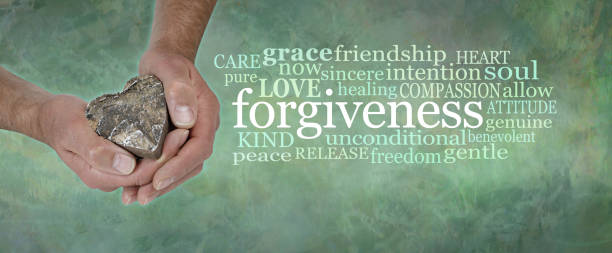
But It Will Change Our Future!
To forgive is a mandate from God, a non-negotiable clause in the contract of faith. In Colossians 3:13, Paul made it quite clear when he said, “Bear with each other and forgive one another if any of you has a grievance against someone. Forgive as the Lord forgave you.“ This directive, however, comes with its own set of challenges. Forgiving someone is one thing; escaping the grip the memories hold over us is another thing altogether. The endless loop this can cause within us makes us a slave to the past. Even the Apostle Peter grappled with the enormity of this task, prompting Jesus to instruct him to forgive “seventy-seven times seven times.” (Read – Matthew 18:21-35—Parable of the unmerciful servant.)
In Heaven’s courtroom, God is the ultimate Judge, and the law is clear regarding forgiveness. The standard you apply to others will be the same standard applied to you. Perhaps that is why Satan and his followers are such legalists when it comes to the law. When forgiveness is ignored, Satan, the accuser of the brethren (Job 1:6, Psalm 109:6, Zec. 3:1, and Rev 12:10), has the right to torment and hold us in contempt of court. For years, I have made excuses for my actions, even to the point of defending my actions as being noble while holding in contempt the actions of others. Then, one day, I realized the adage was true, “When you have yourself for an attorney, you have a fool for a client,” I knew then I needed to get a new attorney, one who knew the law. That was when I asked Jesus to be my advocate who stands before God, pleading my case. It is applied to Christ in (1 John 2:1 and Job 16:19), where the same Greek word is translated as “Advocate.”
And, of course, the Holy Spirit brings forth Godly understanding and truth concerning the situation. It is a name given to the Holy Spirit (John 14:16; 15:26; 16:7) and means another “advocate, or comforter.” As soon as I did, I felt Jesus telling me to gather up every accusation, argument, excuse, and pretense and turn and hand them over to Him in a prophetic act. He then told me not to respond to anything the accuser said. “Since you have forgiven the person, you are free from any accusations the accuser has over you,” Jesus said, ‘From now on, direct all inquiries to Me, your new attorney. Point to me, turn and walk away!’ And I did. When Satan attempted to make me feel guilty, accused, or ashamed, I would point to Jesus, turn and walk away and not entertain any accusation.
His role as my mediator before God reassures me that I am no longer subject to the accuser’s charges. Instead, I am called to focus forward, leaving all my legal battles in the capable hands of Jesus, my advocate. This shift taught me the importance of not engaging with or entertaining the accuser’s lies. My strategy has become simple yet profoundly liberating: point to Jesus and walk away, confident in His complete and unfailing representation. This journey has taught me the power of forgiveness, the importance of divine advocacy, and the freedom that is available when you entrust your case to Jesus!
Six Misconceptions Concerning Forgiveness
1. People believe that forgiving is forgetting that the incident happened. You can’t forget something that took place. However, you can decide to release the offense, and the person into God’s care and justice and no longer act as that person’s Judge or Jury.
2. People believe that not forgiving someone is punishing them. Usually, the person who offended you doesn’t even remember the offense and has gone on with their life. The main person to be affected is the one holding onto the offense which often accelerates to a bitterroot defilement. It is important for us to know that we are actually allowing our offender to still have control over us when we don’t forgive.
3. People believe they can’t forgive. They may say, “I can’t forgive them for what they did to me.” This often comes from a wrong idea of forgiveness. Forgiveness is not forgetting or pretending that something did not happen or even suggesting that what happened was right or did not hurt everyone involved.
4. People believe they must become their friend and re-establish a close relationship if they genuinely forgive someone. Forgiveness does not require you to re-establish a relationship with someone who has a history of abusing or mistreating you; instead, it recognizes the need for appropriate boundaries. Forgiveness works to heal our hearts, and we may find that God has worked that healing in us where a relationship with the person can be re-established. It is not forced upon us but is guided by God’s love, healing us from within as He softens our hearts.
5. People feel justified in their unforgiveness and believe that there are no negative consequences to the unforgiveness and bitterness within them. This is not the Biblical or secular witness. Bitterness adversely affects us physically, mentally, emotionally, and/or spiritually. A significant percentage of people who suffer physically from certain cancers, autoimmune diseases, and ailments in the bones have at least a contributing root of bitterness and unforgiveness. God’s word witnesses the deterioration of our relationship with God when we choose to retain, through bitterness and unforgiveness, the role of the Judge.
6. People believe that when they choose to forgive, the hurt will leave immediately, and they should instantly feel different. When we forgive and give the case to God, the right for the enemy to torment us is removed, and healing can begin. To truly forgive from the heart is a supernatural gift of grace from God, and it is Him who heals our wounds. When the accuser attempts to return and replay the offenses, we quickly go to Jesus, our advocate, and give the case to Him as He is our defender. We can expect to be tested whenever freedom is gained, but we have Jesus, and the Holy Spirit who will defend and sustain us as we give them the case.
Forgiveness is a decision only we can make and is an act of our will to do so. We can understand what it means to forgive and the misconceptions we may have that stop us from choosing forgiveness, but ultimately, it must be our decision. May we pray for the Holy Spirit to be present in His great love and power to set us free as we speak aloud to choose to forgive and to allow God to be the judge.. There is power and spiritual significance in spoken words to break any agreement we have made with the enemy. We pray that if this speaks to you, you will give your case to Jesus and allow Him to defend you in the court of Heaven.
I want to point out from the Eph. 4:26, “In your anger do not sin. Do not let the sun go down while you are still angry.” I heard a teaching that pointed out that it does not say it is a sin to be angry but to not sin in your anger. It really is okay to recognize you are angry and in doing so we need to give that anger to God as He will give you strength and help you deal with and overcome the anger as you ask for His help with any uncontrolled emotion that would lead to sin. I want to add that in many situations it is not the offense itself that gives the demonic a right but the way we respond to the offense that gives the demonic access. May we understand that the key to living and dying well is to learn to love as He loves and to choose to forgive others as He has forgiven us.
With much love in Him always,
If you have been blessed by our articles and know of someone who would benefit from receiving ‘Keys to Kingdom Living’ please forward this article onto them. Or simply tell them to go to our web site, http://www.klifemin.org and scroll down the right side of the page and click on which method they would prefer receiving their copy of the newsletter.
We also appreciate your letting us know if you enjoyed it as well so either bless us with a comment or hit the ‘like’ button.
Leave a Reply